1. INTRODUCTION The law speaks of two kinds of persons. A natural person is a human being, who holds rights and duties by virtue of birth. An artificial or juristic person is an entity that the law chooses to treat as a bearer of rights and duties. Indian courts accepted very early, the Privy Council, for instance, held a Hindu idol to be a juristic person capable of owning property and suing through its shebait1. The company is the most commercially important example. Once the law accepts that a company is a person, the question that arises is, how far may a court look behind that person to the individuals who run it? This article does not enter the deeper jurisprudential debates on legal personality. It takes the personality of the company as its starting point and asks why the veil matters and when it may be lifted. 2. LEGAL PERSONALITY OF THE COMPANY The Indian story begins with borrowed law. Early companies legislation followed English models, and limited liability for non-banking companies arrived only with the Joint Stock Companies Act, 1857, which was consolidated in the Indian Companies Act, 18662. The Companies Act, 2013 now provides that on registration the company becomes a body corporate capable of perpetual succession3. The doctrine originates from the Salomon case. Aron Salomon, a leather boot manufacturer, sold his business to A. Salomon & Co. Ltd., whose seven subscribers were himself, his wife and their five children. In payment he took shares and secured debentures. When the company failed within a year, the debentures ranked ahead of the unsecured creditors, who received nothing. The trial court and the Court of Appeal treated the company as a mere agent or sham for Salomon. The House of Lords unanimously reversed, holding that a validly incorporated company is a distinct person whatever the motives of its founders, and that the statute did not demand that subscribers be independent of one another4. Indian courts adopted the same position. The Supreme Court has held that a shareholder owns shares and not the property of the company5, and that the company’s personality is distinct from that of its members6. Separate personality brings perpetual succession, the capacity to hold property and to sue in its own name, and limited liability for those behind it. 3. WHY LIFTING THE VEIL MATTERS Limited liability pushes the risk of failure onto creditors, and creditors are not all alike. Banks can bargain for security, but employees, tax authorities and tort victims never chose to deal with the company. If a separate personality was to be absolute, a person could successfully escape responsibility, or defeat a statute, and the law would reward form over substance. Lifting the veil is therefore the safety valve that ties the privilege to its purpose. Tan, Wang and Hofmann argue that the theoretical basis of veil piercing generally lies in the abuse of the corporate form7. However if courts lift too freely they destroy the certainty on which investors and lenders rely, if they lift too rarely, incorporation becomes a licence for wrongdoing. 4. WHEN CAN THE VEIL BE LIFTED? 4.1 Statutory exceptions Parliament has itself lifted the veil in several places. Where a company is incorporated by furnishing false information or by fraudulent means, the Tribunal may direct that the liability of its members be unlimited8. The Companies Act, 2013 also imposes personal liability for misstatements in a prospectus and for fraudulent conduct of business9. 4.2 Fraud and sham The oldest judicial ground is the use of a company as a cloak. In Gilford Motor Co. v. Horne, a former employee bound by a non-solicitation covenant formed a company to solicit his old employer’s customers, and the court restrained both10. Further, in Jones v. Lipman, a vendor who had contracted to sell land transferred it to a company he controlled, the court ordered specific performance against both man and company11. 4.3 Evasion of statutory obligations and group enterprises In Life Insurance Corporation of India v. Escorts Ltd., the Supreme Court recognised that the veil may be lifted in matters of tax, welfare legislation and economic offences, and where companies are so interconnected that they form one concern12. State of U.P. v. Renusagar Power Co. went further, looking at the economic reality of a group to decide who was entitled to a statutory exemption13. The Court was more cautious in Vodafone International Holdings B.V. v. Union of India, refusing to disregard a holding structure merely because it was tax-efficient14. English courts have narrowed the ground considerably. Adams v. Cape Industries confirmed that a court cannot lift the veil merely because justice seems to demand it, or because the companies belong to one group15. In Prest v. Petrodel, Lord Sumption separated two ideas. Concealment of the true facts behind a company does not justify piercing; evasion does, but only where a person under an existing legal obligation deliberately interposes a company to defeat it16. 5. A CONTEXTUAL DOCTRINE However, none of these categories works as a formula. Studies have found that courts pierced the veil in roughly 40 per cent of the cases, but outcomes turned on context, and piercing was almost entirely confined to closely held companies17. Indian decisions show the same unevenness. Escorts and Renusagar are generous to the party seeking to lift the veil, while Vodafone is restrained. The cases are best read as an inquiry into abuse in each factual setting, and not as a rule that applies uniformly. 6. CONCLUSION Salomon remains the rule, and the veil is lifted only by way of exception. Yet, separate legal personality cannot become a shield for fraud, evasion of legal obligations or the misuse of corporate structures. The power to lift the corporate veil exists to ensure that the privileges of incorporation should not be turned into instruments of abuse. The challenge lies in maintaining this balance. An approach that permits courts to disregard corporate personality too readily would undermine commercial certainty, while an approach that treats it as absolute could allow individuals to escape obligations through artificial corporate arrangements. The doctrine, therefore, must be applied with caution, guided by the facts of each case and the purpose for which the corporate structure was employed. Ultimately, the question is not simply whether a company and its members should be treated as separate persons, but whether that separation is being used for a legitimate purpose. Corporate personality deserves protection, but it should never become protection for wrongdoing. FOOTNOTES [1] Pramatha Nath Mullick v. Pradyumna Kumar Mullick, AIR 1925 PC 139. [2] The Joint Stock Companies Act, 1857 (Act 19 of 1857); The Indian Companies Act, 1866 (Act 10 of 1866). [3] The Companies Act, 2013 (Act 18 of 2013), s. 9. [4] Salomon v. A. Salomon & Co. Ltd., [1897] AC 22; Rajput Mounica Bai, “Salomon v. A. Salomon & Co. Ltd” Neeti Corporate Services, available at: https://neeticorporate.in/insights/salomon-v-a-salomon-co-ltd (last visited on Oct. 31, 2026). [5] Bacha F. Guzdar v. CIT, AIR 1955 SC 74. [6] Tata Engineering and Locomotive Co. Ltd. v. State of Bihar, AIR 1965 SC 40. [7] Tan Cheng-Han, Jiangyu Wang, et.al., “Piercing the Corporate Veil: Historical, Theoretical and Comparative Perspectives” 16 Berkeley Business Law Journal 140 (2019). [8] The Companies Act, 2013 (Act 18 of 2013), s. 7(7). [9] Id., ss. 34, 35, 339. [10] Gilford Motor Co. Ltd. v. Horne, [1933] Ch 935. [11] Jones v. Lipman, [1962] 1 WLR 832. [12] Life Insurance Corporation of India v. Escorts Ltd., (1986) 1 SCC 264. [13] State of U.P. v. Renusagar Power Co., (1988) 4 SCC 59. [14] Vodafone International Holdings B.V. v. Union of India, (2012) 6 SCC 613. [15] Adams v. Cape Industries plc, [1990] Ch 433. [16] Prest v. Petrodel Resources Ltd., [2013] UKSC 34. [17] Robert B. Thompson, “Piercing the Corporate Veil: An Empirical Study” 76 Cornell Law Review 1036 (1991).
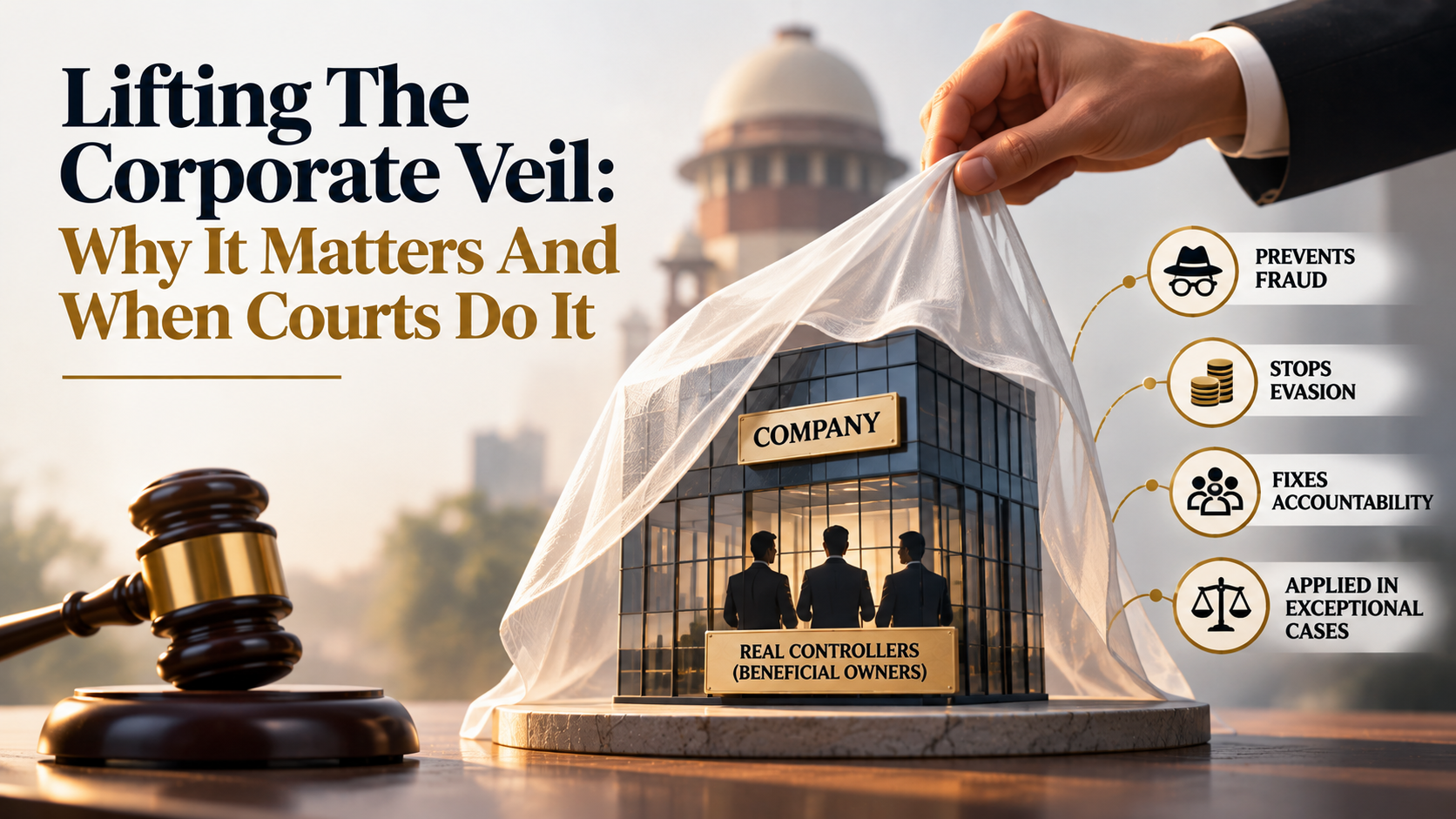
Lifting The Corporate Veil: Why It Matters And When Courts Do It
A company is a person in the eyes of the law, separate from those who own and run it. That separation drives modern enterprise, yet courts have never treated it as absolute. This article examines why the corporate veil matters and when courts lift it.