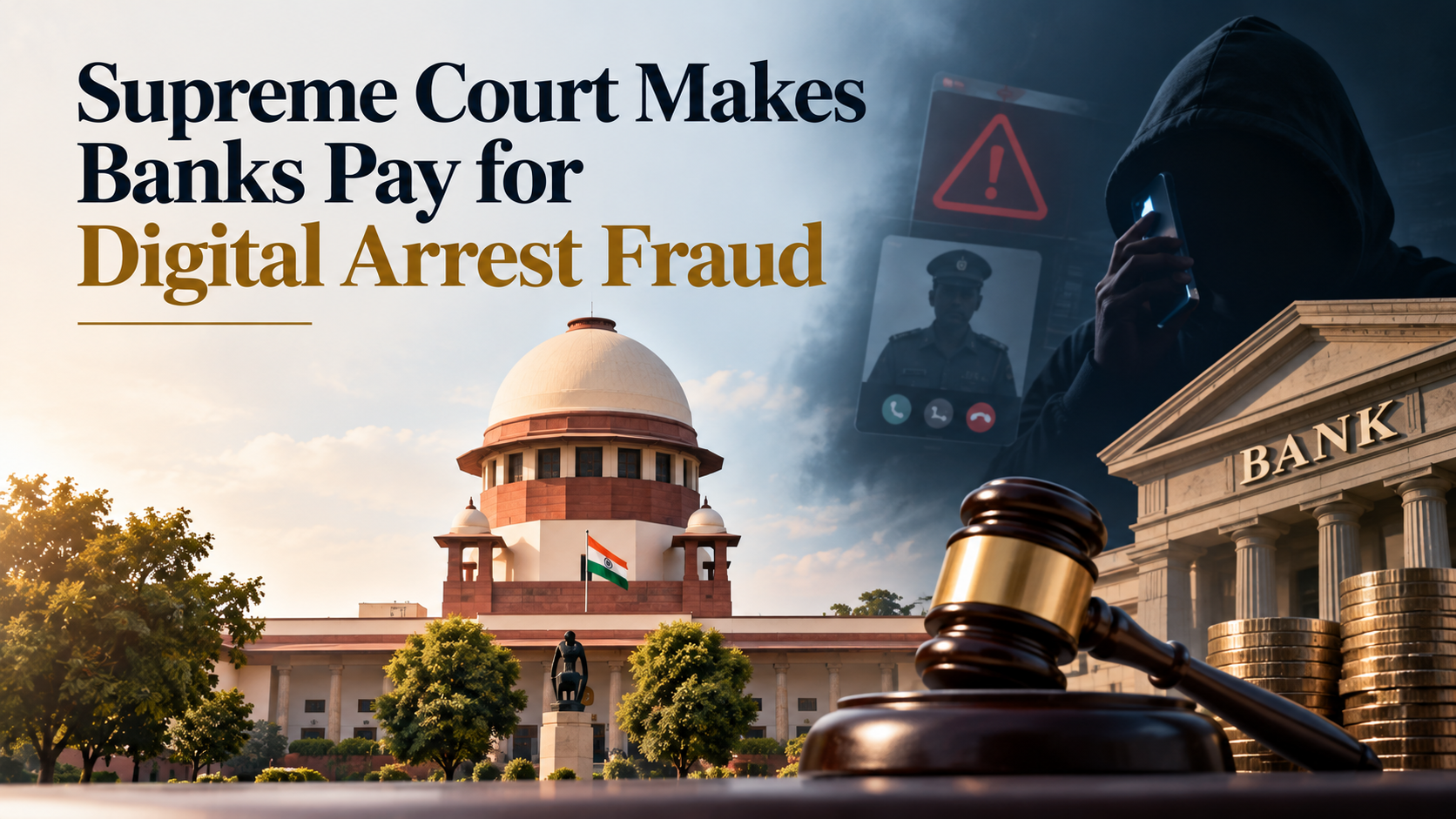
1. Introduction: The Bank Is on the Hook India's "digital arrest" scam has a simple script: a call from a fake agency, a fake arrest threat, and a frightened victim who pays to make it stop. On 29 October 2026, a bench of CJI Surya Kant, Justice Joymalya Bagchi and Justice V. Mohana, hearing the suo motu case In Re: Victims of Digital Arrest Related to Forged Documents (SMW (Crl.) 3/2025), made clear where it thinks the loss should fall: on financial institutions that fail in their due diligence. The order records that RBI's proposed regulations must require banks to indemnify victims, with compensation of not less than the amount lost. The message to banks was blunt: protect your customers, or pay for them. What Is a "Digital Arrest"? The Scam That Arrests You Without Handcuffs There is no such thing as a digital arrest in Indian law. No agency can arrest you over a video call, freeze your accounts over WhatsApp or ask you to "stay on camera" until you pay. That is exactly why the scam works: it is pure theatre. In the general pattern, the victim gets a call or message claiming a parcel in their name carried drugs, or that their account is linked to money laundering. The caller poses as police, CBI, ED or a judge, and the call moves to video. A fake office backdrop, uniforms, ID cards and forged orders follow. In this case the forged papers included a "Freeze Order", an "Arrest Order" and a "Surveillance Order", even fictitious proceedings before the Bombay High Court. The victim is then told to stay on the line, tell no one, and move savings into a "safe" or "verification" account. The money is gone before the call ends. How ordinary people become victims (a general explanation, not drawn from the order): Fear beats logic. The words "arrest" and "money laundering" trigger panic, and panic shuts down checking. Authority is borrowed. A uniform, a stamp or a court order on screen feels real, especially to those who have never met an investigator. Isolation is the trap. "Do not tell your family" cuts off the one call that would break the spell. Urgency closes the deal. Victims are pushed to act within minutes. Seniors are prime targets. The Court's own order noted a pattern of organised crime aimed at senior citizens. The CJI was struck by the sheer gullibility the scam exploits. In a related hearing he reportedly asked, "What kind of people believe they can get arrested on mobile?" The honest answer, and the Court's quiet point, is: almost anyone, once terror, authority and a ticking clock are combined. 2. Background and Development: One Complaint, One Year, One Big Shift 21 Sept 2025: A senior citizen couple writes to the Supreme Court. Between 3 and 16 September, impersonators of CBI, ED and judicial officers, armed with forged court orders sent over WhatsApp, made them transfer Rs 1,05,50,000. 17 Oct 2025: The Court registers a suo motu petition. It is shocked by the forged Supreme Court orders and calls the misuse of the Court's name a "direct assault on the dignity and majesty" of the institution. Notice goes to the Union, the CBI, Haryana and the Ambala cyber police; the Attorney General is asked to assist. 28 Oct 2026: The CJI takes a strong line on the accused, saying that if the law permits, such offenders targeting senior citizens should face punishment even before trial. 29 Oct 2026: The Attorney General says RBI is working on regulatory measures, likely to be operationalised by December. Amicus Senior Advocate N.S. Nappinai says digital arrests continue, the latest reported only a week earlier. The bench asks why RBI is still consulting banks, and proposes strict liability for financial institutions. The story has moved from "catch the fraudsters" to "fix the system that lets the money move." In the CJI's words: the bench said, "unless there's a penal direction to banks, they will not mend their ways!" He also said the biggest financial fraud on the economy has taken place through digital arrests, with thousands of crores lost. 3. Key Features: What the Court Wants in the Rulebook There is no new Act here. This is a court-driven push for regulation, with the Bharatiya Nyaya Sanhita, 2023 supplying the criminal provisions in the FIRs. The features below come from the Court's order and observations. Strict liability for institutions: where fraud occurs because of a bank's failure in due diligence, the bank must indemnify the victim. A compensation floor: payment of not less than the amount lost. "Zero debit" for the victim: the Court's stated view is that the victim's account should not bear the loss. Possible prosecution: the CJI indicated banks could also face prosecution, not just civil liability. A real brake on suspicious transfers: the bench wants unusual transactions held until genuineness is verified in writing, with possible police intimation. Account classification: the CJI asked why banks cannot sort accounts into a few risk groups. Reach beyond banks: the Court asked whether the rules touch intermediaries such as WhatsApp. Insider accountability: liability of bank officials found colluding with fraudsters is under consideration. 4. Opinion and Legal Significance: A Rewrite of Who Carries the Risk Our view: this is the right instinct. Banks see the balances, the transaction patterns and the sudden large transfers by elderly customers. Victims see only a frightening phone call. Putting the loss on the party best placed to prevent it gives banks a real reason to invest in detection. Why it matters legally: Authorised-but-coerced payments. The customer usually approves the transfer, which has let banks argue the loss is the customer's. The Court's approach pushes back on that argument. Judicial direction to a regulator. The Court told RBI what its rules must contain without writing the scheme itself, setting a floor while leaving design to the regulator. Forgery of court authority as a graver wrong. Treating fake judicial orders as an attack on the institution supports a coordinated, multi-State investigation. The caveats: "Strict liability" is tied to a failure of due diligence, so it works as a fault-based test. What counts as due diligence will be fought over. The remark about punishing accused persons before trial is the bench's frustration, not settled law, and sits uneasily with the presumption of innocence. Banks may respond with more account freezes and friction for honest customers. The KYC angle : the reports on the Court’s observations do not mention KYC, but “due diligence” naturally reaches it. Stolen money rarely stays put; it is moved quickly through accounts held by others, often called mule accounts. If a bank opened or kept such an account despite weak KYC checks or obvious red flags, that is arguably a due-diligence failure on the receiving side too. That fits the CJI’s remark that bank officials are sometimes involved. RBI’s KYC rules already expect ongoing monitoring of accounts; readers should check the current Master Direction. A key question to watch is whether RBI’s new rules make the receiving bank liable, not only the victim’s own bank. All of this is still at the stage of hearing and recorded observations, so the final shape depends on RBI's regulations and the next orders. 5. Conclusion: Protect the Customer, or Pay for Them The Supreme Court has put banks on notice. When a lapse in due diligence lets a scam succeed, the cost should not land on a frightened senior citizen. Whether that promise becomes enforceable depends on how firmly RBI defines due diligence and how quickly victims are paid. For now, the direction is clear: the era of "you authorized it, so it's your loss" is under serious challenge. Sources Supreme Court Says Banks Must Compensate Cyber Fraud Victims If It Took Place Due To Bank's Lack Of Due Diligence, LiveLaw In Re: Victims of Digital Arrest Related to Forged Documents, order of 17 Oct 2025, CaseMine
Supreme Court Makes Banks Pay for Digital Arrest Fraud
Scammers posed as CBI officers and flashed forged Supreme Court orders to loot a elderly couple of Rs 1.05 crore. A year on, the Supreme Court is done treating it as a customer's problem. If your bank snoozes while a fraud unfolds, the bank pays. Zero debit for the victim.