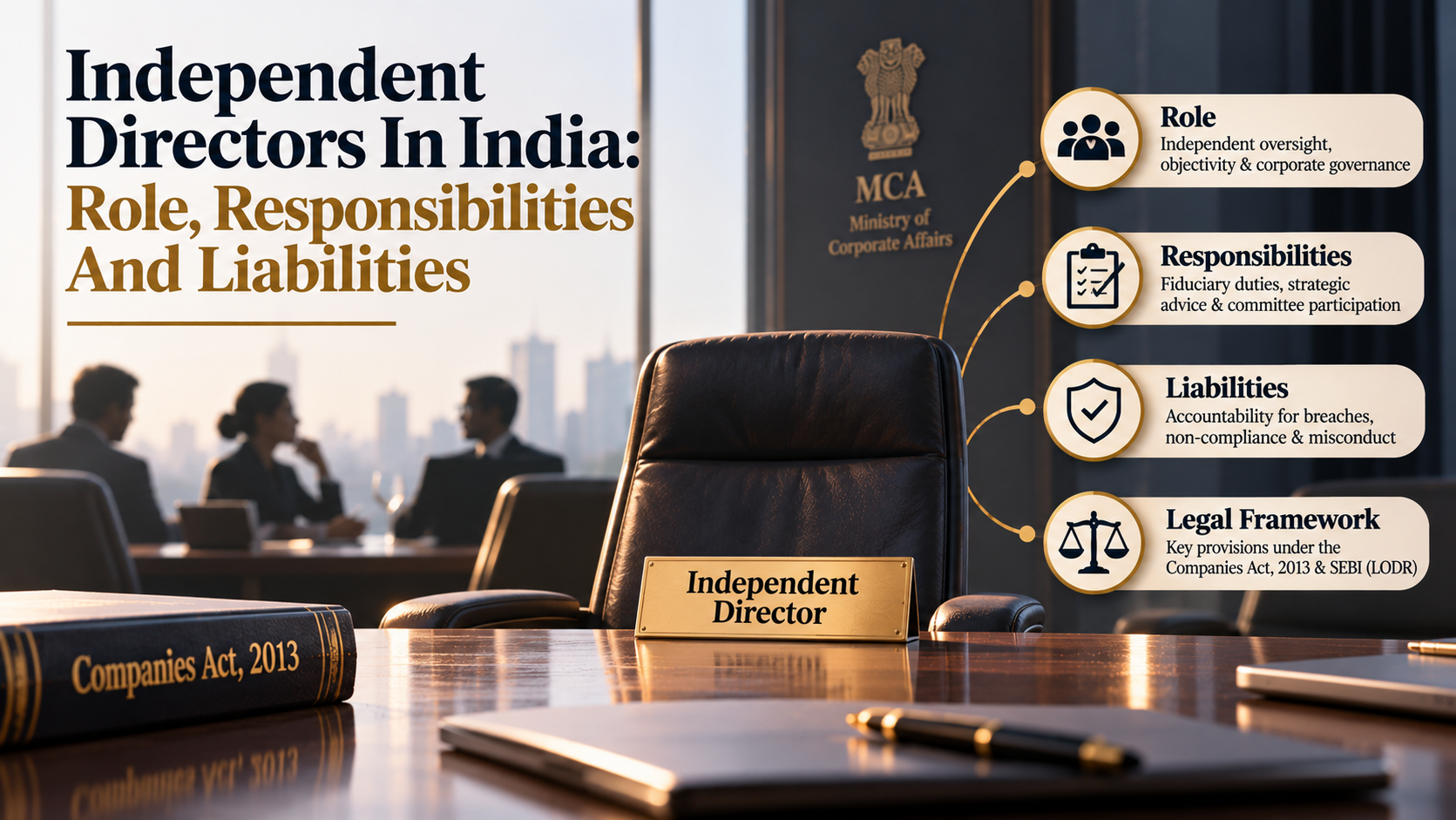
1. Introduction A company’s board of directors is meant to supervise the management that runs its business. In India, that supervision has often been weakened where a single promoter group controls both the company’s ownership and its board. Independent directors were introduced to address this gap. They are non-executive members who are expected to bring objectivity, scrutiny and accountability to board decisions, especially where the interests of promoters and minority shareholders may diverge. This article examines who an independent director is, what the law expects of them, and when they may be held liable. 2. Background India’s corporate governance reforms have largely followed corporate failures. The Naresh Chandra Committee, constituted in 2002, recommended stronger independent oversight of boards. The Satyam Computers scandal of 2009 showed how a board that looked independent on paper could fail to detect large-scale accounting fraud, and it intensified demands for accountable directors. The Companies Act, 2013 responded by placing independent directors on a clear statutory footing.¹ 3. Who is an Independent Director? Section 149(6) of the Companies Act, 2013 defines an independent director as a non-executive director of integrity with relevant expertise who is not a promoter or part of the promoter group and who has no material pecuniary or other relationship with the company that could affect independent judgment.² Each such director must give a declaration of independence at the first board meeting of every financial year and whenever circumstances change.³ Listed public companies must have at least one-third of their total directors as independent directors.⁴ Additionally, tenure is regulated. An independent director may hold office for up to five consecutive years and may serve a maximum of two consecutive terms. A cooling-off period of three years applies after two terms.⁵ This prevents a director from gradually becoming a long-serving insider. 4. Role and Responsibilities Schedule IV of the Act contains a Code for Independent Directors.⁶ It describes their role as guiding the company’s strategy and performance, scrutinising management’s reporting, satisfying themselves that financial controls and risk management systems are sound, and safeguarding the interests of all stakeholders, particularly minority shareholders. The Code requires them to act in good faith, exercise independent judgment, attend meetings regularly and seek further information where what they are given is incomplete. Their work is the most visible in board committees. Independent directors must form a majority of the audit committee under section 177 and must be included in the nomination and remuneration committee under section 178.⁷ For listed companies, the SEBI Listing Obligations and Disclosure Requirements Regulations, 2015 add further obligations, including a familiarisation programme on the company’s business and the director’s role under regulation 25. All directors, including independent ones, are also bound by the general duties in section 166.⁸ These include acting in good faith, exercising due care, skill and diligence, avoiding conflicts of interest, and not achieving undue gain for themselves. 5. Liabilities The central question is how far an independent director can be held responsible for the company’s wrongdoings. Section 149(12) answers the stated question.⁹ An independent director is liable only for acts of omission or commission by the company that occurred with his knowledge, were attributable through board processes, and took place with his consent or connivance, or where he had not acted diligently. The provision recognises that a non-executive director does not run the company’s day-to-day affairs and should not be treated as an insurer of its conduct. Courts have taken a similar approach. In Maksud Saiyed v. State of Gujarat, the Hon’ble Supreme Court held that directors cannot be prosecuted merely because of their office and that specific allegations of their role in the offence must be made.¹⁰ In Sunil Bharti Mittal v. CBI, the Court held that a director’s vicarious criminal liability requires that he was in charge of and responsible for the conduct of the company’s business at the relevant time, unless the statute provides otherwise.¹¹ Liability is not confined to the Companies Act. An “officer who is in default” under section 2(60)¹² may face penalties, and fraud under section 447¹³ carries serious consequences. SEBI can also act against directors for listing and disclosure violations. An independent director who signs off on misleading statements or who ignores red flags they were in a position to notice cannot rely on the title alone. 6. Recent Developments The Corporate Laws (Amendment) Bill, 2026 was introduced in the Lok Sabha on 23 March 2026 and referred to a Joint Parliamentary Committee the same day.¹⁴ The Committee presented its report on 3 August 2026, recommending that the Bill be adopted with clause-wise modifications. The Bill has not yet been passed. As proposed, it would extend the three-year cooling-off restriction for independent directors to the company’s holding, subsidiary and associate companies, and clarify the disqualification grounds based on professional and business relationships. The Committee’s recommendations focus mainly on other areas, such as CSR, auditors and decriminalization, and the independence provisions appear to have been carried forward. Until the Bill is enacted, this article reflects the Act as it currently stands. 7. Conclusion Independent directors are meant to be the conscience of the board and not its decorative members. The statutory framework gives them clear duties and a protected liability position, but that protection depends upon diligence. Courts and regulators expect independent directors to be informed, to ask difficult questions and to dissent where the facts require. Whether they fulfil this role depends less on the wording of the statute than on the culture of the board and the willingness of its members to act. Reform should therefore focus on giving independent directors reliable information and adequate time so that their independence is more than a label. FOOTNOTES [1] The Companies Act, 2013 (Act 18 of 2013). [2] Id., s. 149(6). [3] Id., s. 149(7). [4] Id., s. 149(4). [5] Id., s. 149(10), (11). [6] Id., Sch. IV. [7] Id., ss. 177(2), 178(1). [8] Id., s. 166. [9] Id., s. 149(12). [10] Maksud Saiyed v. State of Gujarat (2008) 5 SCC 668. [11] Sunil Bharti Mittal v. CBI (2015) 4 SCC 609. [12] The Companies Act, 2013 (Act 18 of 2013), s. 2(60). [13] Id., s. 447. [14]The Corporate Laws (Amendment) Bill, 2026, introduced in Lok Sabha on 23 March 2026.
Independent Directors In India: Role, Responsibilities And Liabilities
Independent directors were meant to be the conscience of Indian boardrooms. This article aims to examine their statutory role, responsibilities and the limits of their liability under the Companies Act, 2013 and SEBI’s listing regime.