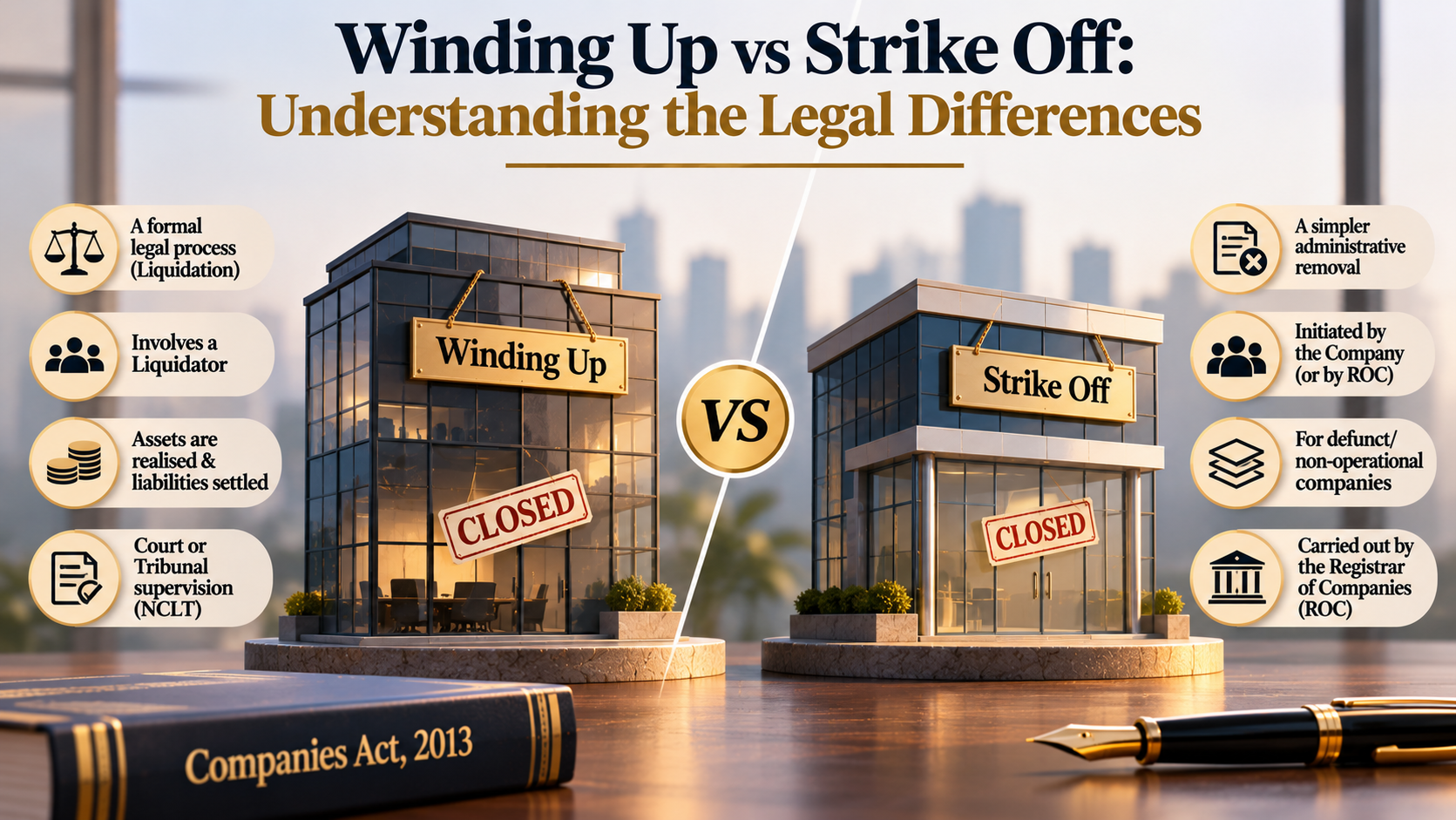
INTRODUCTION Every company must have an inception, functioning and shutting down of operations. Once a company stops functioning or becomes financially infeasible, the company has to be removed from the market in accordance with the Companies Act, 2013 (India's corporate law). The company can be shut down under the processes of Winding Up and Strike Off1. Although both processes lead to the termination of the company, they also differ significantly in relation to the process, legal affects, extent and applicability. This is important to understand for corporate lawyers, liquidators and company owners. CONCEPT OF WINDING UP This is a legal process to formally shut down a company. Assets are gathered and realized. Debts are paid off in accordance with priorities and any leftover monies are distributed to shareholders2. Types of Winding Up: A company can be wound up either compulsorily by the NCLT or voluntarily by members/creditors under the Companies Act, 2013 (alongside the Insolvency and Bankruptcy Code, 2016) due to restructuring or being solvent. Appointment of Liquidator: An official Liquidator/Registered Insolvency Professional will be appointed to gather, manage and inspect claims against the company, whilst managing any current legal processes and distributing the monies. Extensive Process: This is a lengthy process which is either conducted by the courts or monitored by the tribunal. This is applicable to companies who have outstanding debts, legal issues, assets to realize and/or complicated financial issues. CONCEPT OF STRIKE OFF A 'strike off' is commonly known as Fast Track Exit (FTE). This is a process whereby the ROC can strike off the name of a defunct company from the register of companies under section 248 of the Companies Act, 2013. Reasons for strike off: A company can be struck off if they have not begun operations within one year of incorporation or if they have not operated for the previous two financial years3 and have not applied for dormant status under section 455. Voluntary or Suo Motu: An application can be made by the company once all debts have been paid off and a special resolution has passed. Or the ROC can carry out a suo motu strike off if there is reasonable cause to believe the company is not operating. Straightforward Process: This does not involve lengthy legal processes. It is a low cost solution for shell/non-operating companies. DIFFERENCE BETWEEN WINDING UP AND STRIKE OFF ParameterWinding UpStrike Off Applicable LegislationCompanies Act, 2013 & Insolvency and Bankruptcy Code, 2016Section 248 to 252 of the Companies Act, 2013 AuthorityNCLT / Official Liquidator / Insolvency ProfessionalRegistrar of Companies (ROC) Applicable ToCompany who are Solvent or Insolvent with assets/liabilities/legal issues to deal with.Defunct/Non-operating companies with no assets/liabilities. Lengthy and CostlyYesQuick and Low cost Liabilities After TerminationDebts are settled by distributing the assets. Claims will be extinguished.Directors and Officers can still be held responsible for any fraud/misfeasance that occurred within a certain time frame after the strike off.4 CONCLUSION Winding up and striking off have very different objectives. Winding up is a lengthy legal process to deal with complex debts and distribute active estates. Whereas, a strike off is a process to clean up the register of companies of defunct companies. Choosing whether to wind up or strike off depends entirely on the financial status, operations and debts of the company. FOOTNOTES [1] Dr. A.K. Majumdar & Dr. G.K. Kapoor, Company Law and Practice, 24th Edition (Taxmann). [2] Companies (Winding Up) Rules, 2020, Ministry of Corporate Affairs, Government of India. [3] Section 248(1) read with Section 455 of the Companies Act, 2013. [4] Section 251 of the Companies Act, 2013 (Fraudulent application for removal of name).
Winding Up vs Strike Off: Understanding the Legal Differences
A company can be wound up in India either by the process of Winding Up. Or a company can be struck off under section 248 of the Companies Act, 2013.